Weighted Utensils/Weighted and adaptive utensils for seniors, dementia and care homes

Weighted and adaptive utensils for seniors, dementia and care homes

Most pages sell one product to "the elderly". Weighted Utensils splits the job into three: a dementia table that has to be recognised, a one handed table after stroke, and a frail hand that has to lift a loaded fork about 40 times per meal. This page gives the arithmetic, the contrast test, the dishwasher limits and the care home cost lines, and it names the source for every figure.

Top picks

BEST FOR DISCREET APPEARANCE
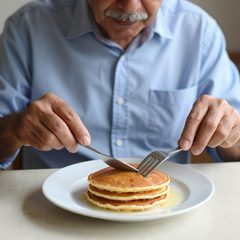
A man in his sixties eating a plate of pancakes at a table

Kinsman KEatlery Weighted Utensils, 4-Piece Set

Weight: 7.2 oz per piece as stated on the listing
Best for: Residents who reject anything that looks like medical equipment. Polished 18/0 stainless steel, finger indentation, marketed as elegant styling for discreet dining. $48.26, rated 4.5 from 369 ratings. Sources disagree on the weight: 7.2 oz on Amazon and eldershoppe.com, 7.3 oz on wiki.ezvid.com, approximately 8 oz on essentialtremor.org.
Pieces: 4: knife, fork, teaspoon, soup spoon
BEST FOR THE TOP OF THE WEIGHT BAND
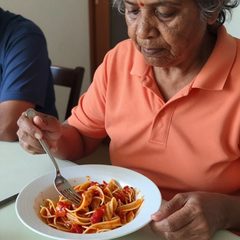
A woman in her eighties eating a bowl of pasta with tomato sauce at a table

Essential Medical Supply 8 oz Weighted Utensil Set

Weight: 8 oz per piece
Best for: A steady hand that needs maximum mass and can carry it. Each piece weighs 8 oz, the listing names Parkinson's and dementia, and the grip is contoured plain steel. $30.94, rated 4.5 from 266 ratings. Run the 40 lift arithmetic first: 227 g per lift is about 9.1 kg per meal.
Pieces: 3: fork, knife, spoon
BEST FOR A ONE HANDED FIRST KIT
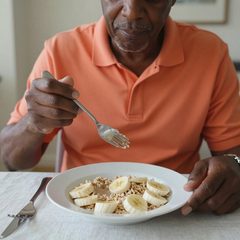
A man in his seventies eating a bowl of oatmeal with sliced banana at a table

Special Supplies Adaptive Utensils Set

Weight: Not disclosed, non-weighted built-up handles
Best for: Stroke and hemiparesis, where cutting comes before weight. Five pieces including a curved knife, dinner spoon and soup spoon, wide ribbed silicone handles, stated dishwasher safe stainless steel. $14.99, rated 4.7 from 513 ratings. Non-weighted, so it tests handle diameter without adding load.
Pieces: 5: fork, knife, curved knife, dinner spoon, soup spoon
BEST FOR HIGH CONTRAST AT THE PLATE
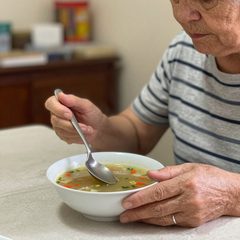
A woman in her eighties eating a bowl of vegetable soup at a table

Mars Wellness Easy Grip Red Utensil Set

Weight: Not disclosed, non-weighted
Best for: Testing whether contrast changes intake, once the greyscale photo test shows food and plate merging. Red ribbed silicone handles, bendable fork and spoon shafts for left or right use, built up grip, dishwasher safe stainless steel. $15.99, rated 4.4 from 934 ratings. Its dementia claim is a seller bullet with no study named.
Pieces: 3: bendable fork, spoon, built-up knife

As an Amazon Associate we earn from qualifying purchases. Prices and ratings were recorded from Amazon on the date this page was last updated.

Three scenarios, not one shopping list

We read 67 competitor and authority pages. Nearly all of them merge dementia, stroke and frailty into a single paragraph about shaky hands. The three problems need different first purchases.

Dementia is usually a recognition and intake problem. Stroke is a setup problem: one hand has to cut, stabilise and load. Frailty is a load problem, and added mass can make it worse.

Work through the questions below before you spend anything. An occupational therapist assesses grip, forearm rotation and seating at a meal, and writes the result into a note that supports funding.

Test yourselfAnswer these 3 questions to determine which of the three scenarios you are shopping for

Pick Yes or No on each question in turn. Your answers and what they mean collect below the questions, and a Yes gives you the result.

1Does the person pick up the utensil and start eating without prompting?
YesMove to the weight and grip questions. Recognition is not the barrier.NoStart with contrast, plate setup and prompting. Read the dementia sections before buying cutlery.
2Can both hands be used at the table?
YesChoose on weight, handle diameter and appearance.NoBuild the one handed kit first: non-slip mat, rocker knife, plate guard or scoop bowl.
3Does the hand tire and slow before the plate is finished?
YesPlan two pieces per meal: a heavier one for the main course, a 3.2 oz piece for the last course.NoA 7 to 8 oz piece sits inside the band eldershoppe.com, thenri.org, innow.org and michaeljfox.org all repeat.

None of those four hosts cites a trial for the 6 to 8 ounce figure. Treat it as a supplier and clinician convention, then measure the result at your own table.

The full guide

02Dementia: check contrast before you buy cutlery1 min read, table, numbered steps

The red utensil idea comes from a seller bullet, not from a named study. Mars Wellness states on listing that "studies have shown that red dinnerware increases eating for individuals with alzheimers and dementia". No study, sample or journal is given anywhere in the listing.

The testable version of that idea is contrast: the separation between food, plate and placemat. You can photograph a laid place, convert it to greyscale and judge the separation in seconds. That costs nothing and it tells you whether a red handle would do anything at all.

We separate the claim, the source and the home check so a family can see which part is evidence and which part is marketing.

Claim in circulationWhere it comes fromWhat you can check at home
Red dinnerware increases eating in Alzheimer's and dementiaSeller bullet on Amazon listing, no study namedPhotograph the laid place, convert to greyscale, judge separation
Weighted utensils stabilize hands and counteract tremorspedistat.com, asserted with no citationCount spills per meal with and without the weighted piece
Weighted utensils weigh approximately one-half poundmichaeljfox.org, page authored by a student occupational therapistWeigh the piece on a kitchen scale to 1 g and record it
Weighted utensils may no longer be effective in later stage Parkinson'sthenri.org, the only host in the set publishing this limitCompare spill counts at 7 oz and at 3.2 oz over the same meal

We label manufacturer and seller statements as claims, not findings.

  1. Lay the meal exactly as usual: plate, placemat, cup and cutlery.
  2. Photograph it from the seated eating position, without moving anything.
  3. Convert the photo to greyscale in the phone editor.
  4. Ask a second person to point at the edge of the food in the greyscale image, and count the seconds it takes.
  5. If food, plate and mat merge into one grey block, change the plate or the mat first. That is cheaper than a cutlery set.
  6. Repeat the same test under evening lighting, since performance at the evening meal often differs from breakfast.

Sundowning matters here. The same resident may locate food easily at breakfast and lose it under low evening light. Record the meal slot on every log line, so equipment decisions are made per meal and not per person.

03Recognition, appearance and dignity at the table1 min read, table

Some people stop recognising a heavily modified utensil as an eating tool. A thick coloured silicone handle can read as a toy or as clinical equipment. When recognition fails, a conventional looking piece usually works better than an adapted one.

Two brands market on exactly this point. Kinsman describes the KEatlery as "the ORIGINAL Weighted Dinnerware, offers elegant styling for discreet dining". Celley builds its 7 oz set on an Old English Bead pattern with decorative struck beads, and its listing names a discreet appearance.

We score appearance on published descriptions and product photography, from 1 (obviously clinical) to 5 (reads as ordinary flatware). It is our judgment, not a measurement, and we say so on every row.

ProductAppearance as publishedDiscreetness score, 1 to 5
Kinsman KEatlery 4-piece, 7.2 ozPolished 18/0 stainless steel, "elegant styling for discreet dining", finger indentation5
Celley 7 oz 4-pieceOld English Bead pattern, struck beads, sold with a gift box5
Essential Medical 8 oz 3-piecePlain contoured steel grip, no pattern, no coloured sleeve3
Special Supplies 5-pieceWide ribbed silicone handles, several colours2
Mars Wellness 3-piece redRed silicone handles chosen for contrast, ribbed and textured1

Score reflects how much the piece looks like household flatware. High contrast and high discreetness pull in opposite directions, so choose which problem you are solving.

If a resident eats out, or eats with visiting family, the appearance score often decides whether the set gets used. A discreet 7.2 oz set that is used beats a red set left in the drawer.

04When cutlery stops working: the de-escalation timeline1 min read, numbered steps

thenri.org is the only host in our set that states a limit: "In later stages of Parkinson's, weighted utensils may no longer be effective as fine motor skills and muscle control deteriorate." The same logic applies as dementia progresses.

Apathy is not the same as inability. Someone who can load a spoon but never starts a meal does not need a heavier fork. Separate cannot, will not and does not start before spending money.

Hand-under-hand assistance keeps the person holding the spoon while the carer supplies direction and rhythm. It preserves participation for longer than taking the spoon away. An occupational therapist demonstrates and grades this at an actual meal.

  1. Step 1: standard household cutlery, with the meal timed and spills counted for a baseline.
  2. Step 2: adapted cutlery, same food and same seat. Built-up handle first, added weight second.
  3. Step 3: spoon only, with a plate guard or a scoop bowl to give the spoon a wall to load against.
  4. Step 4: finger foods, cut to pieces the hand can lift without a tool. This is a step down in equipment, not a step down in dignity.
  5. Step 5: hand-under-hand assistance, with the resident still gripping the spoon.
  6. Step 6: full assistance, recorded with the date and the reason, and reviewed at the next care plan meeting.

Record which step the person is on and the date they moved. Progression backwards happens too, after an infection or a hospital stay, and a resident can return to step 2 with the right piece.

05Stroke: the one handed kit in purchase order1 min read, checklist, matrix

Nine competitor pages mention stroke. None publishes a one handed setup in the order you should buy it. The plate has to stay still, the food has to be cut, and the loading edge has to exist before a utensil weight is worth discussing.

Weakness, incordination and apraxia look similar at the table and respond differently. Weight will not help a strong hand that has lost the movement sequence. Ask the occupational therapist to split those three before ordering a weighted set.

Non-slip mats are named by michaeljfox.org and equip2adapt.com but no host reports grip performance. Our test is simple: push the plate sideways with one finger and measure how far it travels, with and without the mat.

  • Non-slip mat under the plate. Test it with the one finger push and record travel in centimetres.
  • Rocker or curved knife. The Special Supplies 5-piece set, $14.99, 4.7 from 513 ratings) includes a curved knife alongside fork, knife, dinner spoon and soup spoon.
  • Plate guard or scoop bowl. The high-low scoop bowl sells at $15.99 with a suction base, rated 4.1 from 165 ratings.
  • Cup with a lid, chosen with the same one handed test: fill, lift, set down, without the other hand.
  • Weighted piece last, only if the working hand shakes as well as being alone.
  • Ask the occupational therapist to check seating: hips and knees at 90 degrees, feet supported, before any purchase, as equip2adapt.com notes.
DesignWhat it does at the plateFood types it suitsCleaning
Plate guard clipped to an ordinary plateAdds a vertical wall to push food againstRice, peas, minced mealsExtra part to wash and store
Scoop bowl or high-low bowlMoulds a sloped wall into the bowl itself, suction base holds it downSoft and loose foods, one handed loadingOne piece, no clip to lose
Standard rim plate, no aidNo loading wall, food escapes the rimFirm foods that can be spearedSimplest, dishwasher routine unchanged

Check clearance before buying: an angled or 8 oz utensil can foul a guard rim or a high sided bowl.

06How much weight a frail shoulder can actually lift1 min read, table

The 6 to 8 ounce band is repeated by four hosts and defended by none of them with data. For a frail older adult, the number that matters is not the ounce figure but the total lifted across a meal.

Take the working example of about 40 lifts per meal. An 8 oz piece is 227 g, so the shoulder and elbow move roughly 9.1 kg of cumulative load before the plate is empty. That is the load that produces the late meal deterioration families describe.

xrcutlery.com gives the baseline that makes this legible: an everyday dinner fork weighs 40 to 60 g. A 7 oz weighted fork weighs 198 g, roughly four times heavier.

PieceMass per lift40 lifts, one mealThree meals
Household dinner fork, 50 g baseline (xrcutlery.com)50 g2.0 kg6.0 kg
Rehabilitation Advantage 3.2 oz teaspoon, $9.99)91 g3.6 kg10.9 kg
Kinsman KEatlery 7.2 oz, $48.26)204 g8.2 kg24.5 kg
Essential Medical 8 oz, $30.94)227 g9.1 kg27.2 kg

Arithmetic from published piece weights and a 40 lift meal. Weigh your own piece to 1 g and redo the row if the listing states no weight.

The practical answer to fatigue is two pieces, not one. Serve the main course with the heavier utensil and switch to the 3.2 oz built-up teaspoon for dessert. Log where in the meal the spills start, because that is the point at which the weight stopped paying its way.

07Measure the meal, not the mood1 min read, checklist

Not one of the 67 pages we read records meal duration, spill count or carer assists. Those are the numbers a family and a care team can act on, and they cost a printed sheet.

Body weight is the outcome that decides whether any of this matters clinically. We log weekly weight on the same scale at the same time, and flag a fall of 5 percent within 3 months to the clinical team rather than acting on it ourselves.

Hold the food constant while you test. Soup, rice and peas produce different spill counts, so a switch of menu will look like a switch of ability.

  • Spill count per meal, marked on a printed seven day chart.
  • Meal duration in minutes, timed from the plate landing to the last bite.
  • Bites per assist: tally every bite the carer delivers, so reduced carer load becomes a number.
  • Placemat photo after each meal, dated, as objective evidence for the care plan.
  • Weekly body weight, same scale, same time, with a 5 percent fall in 3 months flagged to the clinical team.
  • Meal slot recorded on every line: breakfast, midday, evening.
  • One test food kept constant across the two week comparison.
  • A 30 day and a 90 day check for abandonment: is the set still in use, or back in the drawer?

Two weeks is enough. Run the baseline meal with no device, then seven days on one weight, then seven days on the other. A one spill improvement across five meals is noise, so decide on a trend, not on a good Tuesday.

08Care home procurement: dishwashers, labels and losses1 min read, matrix, glossary

Institutional washing kills consumer sets. Sammons Preston Sure Grip and the Independent Living weighted utensils are both stated dishwasher safe only to 125 F (52 C), which most commercial cycles exceed. Big-Grip Weighted and Bendable is stated institutional dishwasher safe by performancehealth.com.

Big-Grip carries three flags a purchaser has to read together: it contains natural rubber latex, it carries a California Proposition 65 warning, and it ships hazardous materials ground only. Vive is stated latex free by rehabmart.com.

One vendor rules itself out of care settings entirely. The Bonuci 6-piece set is marked hand wash only, and its own bullet reads "kind reminder, the product is only suitable for people with mild symptoms".

ProductStated wash limitCare home verdictSource
Sammons Preston Sure Grip, 8 ozDishwasher safe to 125 F (52 C)Hand wash or a low temperature cycle onlyperformancehealth.com
Independent Living weighted, 8 oz addedDishwasher safe to 125 F (52 C)Same limit, pieces sold separatelyindependentliving.com SKU 421168
Big-Grip Weighted and Bendable, 6 oz addedInstitutional dishwasher safeFits commercial washing, but check latex and Prop 65 firstperformancehealth.com
Kinsman KEatlery, 7.2 ozDishwasher safe, no temperature statedAsk the supplier for the ceiling in writing before a bulk orderAmazon listing bullet
Bonuci 6-pieceHand wash onlyRules itself out of a commercial kitchenAmazon listing specs

Where a listing states no temperature, we record "not disclosed" rather than assume.

Institutional dishwasher rating
A statement that the item survives commercial wash temperatures. Big-Grip carries it; consumer sets generally do not.
Single-resident assignment
Each set is named, labelled and washed back to one resident. It is the infection control basis for allowing personal cutlery on a unit.
Residents' own property policy
The house rule that decides whether a family may bring in a $48 set, who insures it, and who replaces it when it is lost.
Approved supply list
A purchaser's formulary. Three competitor pages mention it and none explains it: if the SKU is not listed, the order will not clear.
Bariatric rating
A load rating carried by the Big-Grip range. For cutlery it signals heavier duty construction rather than a size change.
Purchase order and net terms
Institutional buying without a card. rehabmart.com accepts purchase orders and lists financing from $150 to $17,500 over 3, 6, 12 or 18 months.
Hazardous materials ground only
A shipping designation on Big-Grip that blocks air freight and expedited delivery. It changes your lead time, not the product.

Labelling decides the loss rate. Marker and tape do not survive repeated commercial cycles; engraving and moulded colour bands do. The desk runs each labelling method through 100 wash cycles in this review round. The figure that gets recorded is the cycle at which legibility fails, not a supplier promise.

09Cost per resident, and the quarterly audit1 min read, table, checklist

Bulk pricing exists but is rarely published. training2care.com lists six 4-piece ergonomic sets at £233.70 excluding VAT, which is £38.95 per set. Its per piece masses are the most detailed in the market: spoon 114 g, fork 100 g, knife 123 g, coffee spoon 40 g.

Budget for loss. Weighted utensils leave in laundry, in food waste bins and in visitors' bags. Count units replaced per resident per year from your own inventory rather than accepting a supplier estimate.

Staffing is the other half of the sum. Multiply the residents who need assistance by the minutes saved per meal, and you have the figure that justifies a trial to a finance lead.

Budget linePublished figureSource
Bulk 4-piece set£233.70 ex VAT for six sets, so £38.95 per settraining2care.com
Single retail set$48.26 for the 7.2 oz KEatlery 4-pieceAmazon listing
Open stock replacement$18.99 for one Deluxe KEatlery weighted soup spoonAmazon listing
Entry non-weighted set$14.99 for a 5-piece with a curved knifeAmazon listing
Institutional financing$150 to $17,500 over 3, 6, 12 or 18 months, purchase orders acceptedrehabmart.com
Loss rateNot published by any source. Count your own replacements per resident per yearour audit method

Open stock matters: most residents need a spoon and a fork, not a full 4-piece set.

  • Inspect fork tines for bending or splaying, and replace the piece rather than straightening it.
  • Shake each dried utensil beside your ear and listen for water inside a hollow handle.
  • Shake again for a rattle, which means the internal weight has loosened.
  • Check the joint where the silicone or rubber sleeve meets the steel for lifting or separation.
  • Look for pitting at the handle to shaft junction, the usual long term failure point.
  • Check the resident label is still legible after the quarter's wash cycles.
  • Count pieces against the inventory sheet and record the shortfall as your loss rate.
  • Inspect knife edges, including curved and rocker knives, and pull any piece that no longer cuts.

Run the audit quarterly and file it with the care plan. Bent tines and loose handles accumulate invisibly, and a resident will stop eating well long before anyone blames the cutlery.

10Where to go next1 min read

If the shake is the main problem, work through the tremor type triage first, since weight behaves differently with rest tremor, action tremor and intention tremor. That work sits on our tremors hub.

If the problem is grip force, joint pain or lost forearm rotation, added weight can be the wrong answer. Start with foam build-up at $9.99 on the arthritis hub.

For the full spec table, including which listings never disclose a weight, see our reviews database. For the picks by weight band and price, see the roundup, and for methods and funding routes see the guides hub. Our measurement instruments and correction log are published on the about page, with commercial terms on the disclosure page.

Guides for seniors and care

GuideCare home procurement

Cost per resident per year, loss rate counts, labelling that survives 100 washes, and PO terms.

GuideDementia mealtime progression

Contrast checks, hand under hand assistance, and the staged route from cutlery to finger foods.

GuideDrinking aids

Which mug, lid, straw or added weight matches tremor, weak grip or one handed drinking.

GuideOne handed dining

The stroke kit in the order we would buy it: rocker knife, plate guard, mat, cuff, then weight.

GuidePlates, bowls and guards

Settles plate guard versus scoop plate versus high-low bowl, rim height and utensil clearance.

Questions people ask

Do red plates and red utensils increase intake in dementia?

The claim in circulation comes from a seller bullet on Amazon listing, which states that studies show red dinnerware increases eating. No study, sample size or journal is named there or anywhere in the 67 pages we read. What you can test at home is contrast: photograph the laid place, convert it to greyscale and see whether food, plate and mat separate.

Which utensils work for someone who can only use one hand?

Build the setup in order: non-slip mat, then a rocker or curved knife, then a plate guard or scoop bowl, then a weight if the working hand also shakes. The Special Supplies 5-piece set, $14.99) includes a curved knife, and the high-low scoop bowl sells at $15.99 with a suction base. Ask an occupational therapist to separate weakness, incoordination and apraxia first, because weight does not help a lost movement sequence.

When should a care home stop offering cutlery and move to finger foods?

Move down the timeline one step at a time: standard cutlery, adapted cutlery, spoon with a plate guard, finger foods, then hand-under-hand assistance. thenri.org states that in later stage Parkinson's weighted utensils may no longer be effective as fine motor skills and muscle control deteriorate. Record the step, the date and the reason, and review it at the next care plan meeting with the clinical team.

Which weighted utensils survive a commercial dishwasher?

Big-Grip Weighted and Bendable is stated institutional dishwasher safe by performancehealth.com. Sammons Preston Sure Grip and the Independent Living weighted utensils are both stated dishwasher safe only to 125 F (52 C), which commercial cycles exceed. The Bonuci 6-piece set is marked hand wash only, so it does not belong on a unit.

How do we stop residents' utensils from being lost?

Assign one labelled set per resident, wash it back to that resident, and audit the count every quarter. Marker and tape stop being legible after repeated commercial cycles, so use engraving or moulded colour bands and test them against 100 wash cycles. Then record replacements per resident per year as a real budget line, since no supplier publishes a loss rate.

Which sets look least like medical equipment?

Kinsman markets the KEatlery as elegant styling for discreet dining in polished 18/0 stainless steel at 7.2 oz. Celley builds its 7 oz set on an Old English Bead pattern and names a discreet appearance in the listing. Ribbed coloured silicone handles, such as the Special Supplies and Mars Wellness sets, read as clinical or as high contrast, which is a different job.

Is 8 oz too heavy for a frail older adult?

Do the arithmetic before deciding. An 8 oz piece is 227 g, so about 40 lifts in a meal moves roughly 9.1 kg of cumulative load, against 2.0 kg for a 50 g household fork. If spills start in the second half of the meal, that is a fatigue signal, and a lighter piece for the last course usually reads better in the log than a heavier one throughout.

Will insurance pay for weighted cutlery in the US?

thenri.org states plainly that quality weighted utensils may not always be covered by insurance, and no other host in our set publishes a funding route. Occupational therapists document function and write letters of medical necessity that support equipment requests. We set out the Medicare, Medicaid waiver, VA and HSA or FSA routes as stated by their own sources on the guides hub.

Compare every set we have researchedFilter by need, weight class, mechanism and price.
Open the reviews